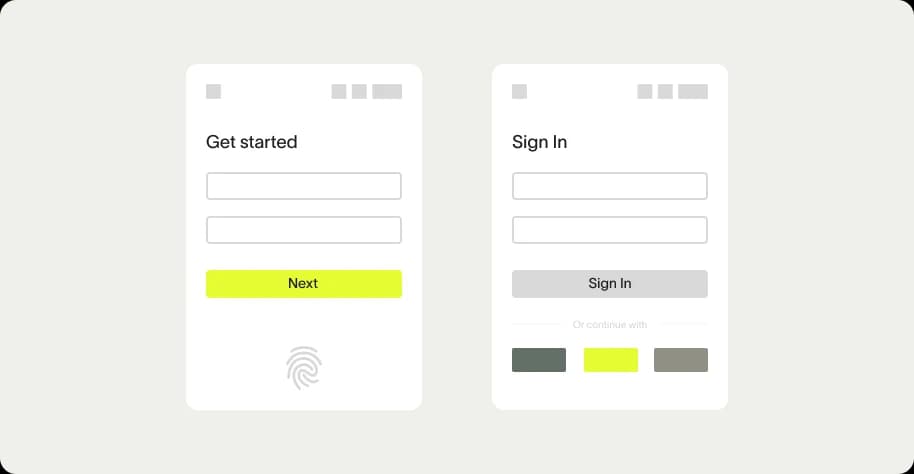
The need for various forms of user authentication systems is increasing. Organizations must recognize that passwords are not the exclusive means of authenticating users. There are several authentication technologies and even more activities that need authentication mechanisms.
What Is Authentication?
Authentication refers to an electronic technique that allows a person to be identified. It may be used to certify the origin and integrity of data in electronic forms. One example could be the issue of a digital certificate to verify the legitimacy of a website. The general goal of authentication is to decrease the possibility of fraud, particularly when someone misrepresents their identity or uses another person's credentials without authorization.
Mobile login flows types
Web-based or native login processes can be used in mobile apps. It is vital to distinguish between the two:
- Users submit their credentials into the app when using the native login flow.
- Users are sent to a web login screen. That's where they submit their credentials when using the web-based login flow.
For a better user experience, we suggest adopting the native login flow.
Authentication factors
When authenticating an internet user, three types of factors may be employed. The reason is to ensure that the user is who they claim to be. These are the factor categories:
- Knowledge factors include a user's password, passcode, and personal identification number (pin). Here, the user must answer a pre-selected security question.
- Ownership factors are items in the user's possession. They could be a bank card, a hardware or software one-time password (OTP) token, or a mobile phone.
- Inherence factors. They are factors that relate to what a user is or does, and they include biometric identifiers. It can be the face, fingerprint, or retinal pattern recognition. Other personal attribute identifiers can be used as well.
Types of Authentication
The following classification contains the most common kinds of online user authentication. The increasing level of security organizes them:
Email & password combination
Passwords were used as a simple means to safeguard information for a long time, almost 50 years. We've been using them to access computers, IT systems, gadgets, and internet services. Passwords were unsafe from the start, and that hasn't changed. We are told to use stronger passwords, to make them unique, to not reuse them, and to change them regularly.
Nowadays, most passwords are easy and general. They are based on information that is easily obtained through social engineering. This is why many service providers are abandoning passwords. Many firms expect that they will soon be password-less.
SMS two-factor authentication
SMS-based two-factor authentication is old authentication technology. It's not secure enough for storing sensitive information. For a long time, it was thought to be an increased security mechanism, but, that is no longer the case.
SMS authentication however can be a viable alternative for startups that don't require a lot of protection on their services, as a rule of thumb, if your app doesn't require storing sensitive data -- such as cards, addresses, etc. SMS authentication is good to go.
Third-party authentication apps
Another alternative is to use third-party authentication software. And there are many of them. Some applications provide enough security as long as the user has control of the device. They are pretty horrible from an user experience point of view. Users must switch applications to get the code. Then they return to input it, thus most will avoid doing so and instead opt for lesser security settings.
Biometric Authentication
Biometric authentication is the technique of verifying an individual's identification. It uses a unique bodily trait. For each authentication, the user delivers biometric data. Then the biometric data is compared to the input. This approach was designed to be safe, and it continues to be, as long as it functions well.
Although the user experience is positive, biometrics fall short in terms of privacy. Not everyone is ready to use their bodily traits for verification, even if the biometric data does not leave their device.
So, what to choose?
As a general answer, it depends, sometimes SMS or user/password authentication is enough, and sometimes an extra layer of security needs to be added. Depending on the app, the data is manipulated and stored, and different authentication methods are required.
If you're not sure what should you pick for your mobile app, get in touch and our team of experts will offer you the best alternatives for your use case.